contents: the early days 1472-1699 CE | things can only get better – the 1700s | further reading and references
in preparation: the revolution in farming, industry, learning and communication – the 1800s | world wars, oil and alternative energy – the 1900s
see also: A (very) brief history of Burray and South Ronaldsay – the early years (11000 BCE – 1472 CE)
Scottish and British rule (1472-1699) – the early days
One of the striking features of this era is that, compared to its forerunner, the ‘Viking / Norse / Scandinavian Period’, relatively little attention has been given to Orkney, Shetland, and other islands by mainstream writers. Yet it was a time (particularly from 1540 to 1814) when there was, as Peter Marshall puts it, ‘a sequence of dramatic – and often traumatic – processes, which profoundly reshaped patterns of society and redirected the course of countless individual lives’ (2024: 3). As he goes on to show, islands like Orkney were ‘revelatory places’ in this respect. They raised important questions around the nature of nationality and identity, and are paradoxical places:
As communities, they are prescribed by the clearest. most non-negotiable of boundaries. But they can also so be surpisingly open and permeable, the encircling sea as much a conduit as a barrier. In relation to mainlands, they are by definition marginal, if not isolated and secluded. Yet by virture of participation in trade and proximity to sea-lanes, islanders often enjoy greater contact with the outside world than inhabitants of inland regions. (Marshall 2024: 5-6)
We also need to bear religious change in mind, given its impact on many people’s lives at this time. During the fifteenth century, there appears to have been a decline in monastic life in Scotland and a rise in the number of friars looking to minister and preach in local communities. Other developments questioned the Catholic Church’s operations and beliefs, and revealed corruption. We also see the growing influence of humanism and the work of Desiderius Erasmus (1466–1536) and others, particularly in the early Sixteenth Century.
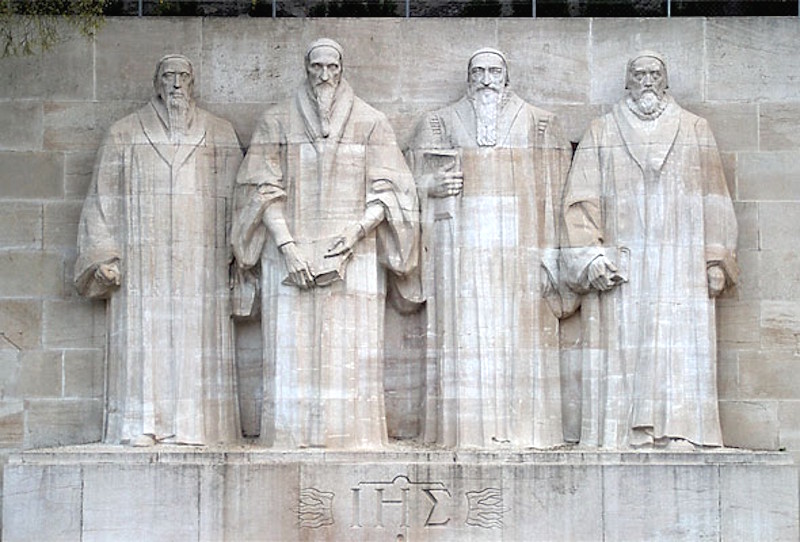
There was a growing belief in the need to question and explore the Church’s teaching and practices. By the 1520s, Martin Luther’s work and beliefs were also reaching Scotland. By the 1550s, there had been significant growth in Protestantism, including Calvinism, and in the number of churches embracing it. One important change was that services were normally conducted in English rather than Latin or Norn. That said, the ‘Protestantisation’ of chapels and churches was a slow process away from Kirkwall, and probably especially so on islands like Burray and South Ronaldsay (Marshall 2024: 120). Norn lingered on as part of the vocabulary of a significant number of local people.
Protestant Lords grouped and began to organise to gain control of the Scottish Parliament so that legislation could be passed to establish Protestantism and to reject ‘Papal supremacy’. In 1560, after a period of significant conflict, they gained control of the Scottish Parliament. Legislation was passed that, in effect, abolished many elements of Catholic status and practice (such as Mass). It also eliminated Papal jurisdiction in Scotland and reduced the sacraments to two: communion and baptism. Celebrants had to be Protestant.
Not surprisingly, Mary Queen of Scots, who had spent much of life since birth (in 1541) and been brought up in France as a Roman Catholic, refused to sign the Acts passed by the Parliament. The 1560 Act was signed, as was legislation that was clearly Calvinist in orientation. There was, for example, a concern for simplicity in worship and a focus on the Bible.
Mary returned to Scotland in 1561. However, in 1567, she was forced to abdicate, and her son James VI (aged 13 months) took over, with a series of regents making decisions. Mary had married Lord Bothwell (who was then elevated to the Dukedom of Orkney), and this, in turn, led a large number of Scottish peers to raise an army, take the Queen to Edinburgh, and demand her resignation. Bothwell’s dukedom was rescinded, and he was forced into exile.
Troubled times
In Orkney, the power of the Sinclairs waned, in part, because of conflicts between different factions within the family. In 1529, this led to the Battle of Summerdale/Summers Dale between the Orcadian Sinclairs and the Caithness Sinclairs (click for map). It is said to be the last battle on the Orkney mainland. The Orcadians won and appear to have killed nearly all their opponents (500 men).
Summerdale didn’t end the problems faced by the Orcadian Sinclairs. New aristocratic families had appeared. In the process, one family – the Stewarts – came to the fore. Robert Stewart (1533-1593), the illegitimate son of James V of Scotland and a half-brother of Mary Queen of Scots, became the 1st Earl of Orkney. Along with his son Patrick, he is remembered ‘for the hardship and cruelty of their times, and this period was to herald an all-time low for the people of Orkney’ (Wickham-Jones 2013: 153).
If Robert Stewart was bad, his son Patrick was even worse. He was known as ‘Black Patie’, and ‘became a symbol of coercion, cruelty and tyranny’ (Marshall 2024: 154). ‘Black Patie’ was executed in 1615. His father, Robert Stewart, had been hanged a short time before him.
In 1603, the situation began to change. On the death of Queen Elizabeth I, James VI of Scotland (the son of Mary Queen of Scots) became James I of England. This had fundamental repercussions (see Jackson 2025). In March 1611, for example, a decree was issued stating that it was the will of the king that his subjects should ‘live and be governed under the laws and statutes of this realm only, and by no laws of foreign countries’ (op. cit.: 165). This went beyond the 1472 Act by excluding external laws and including England. Orkney and Shetland had formally become part of Britain, and Norse law had been set aside.
While these were radical changes, they probably didn’t have a major impact on the lives of ‘ordinary people’. As Rosemary Hebden (2008: 26) put it, they were no better off under the system that followed the end of Earldom, and probably did not notice any change. However, in the case of Burray, some significant alterations to local life resulted from the actions of some members of the Stewart family. From 1550 to 1768, Burray was in the hands of the family (Struthers 2013: 15-27).
The Bu estate was the centre of much activity. There was a house here from Norse times, and perhaps even earlier, but William Stewart of Mains and Burray (circa 1575-1661) looks to have rebuilt it in the 1640s. Struthers draws our attention to his coat of arms (dated 1649) on the north wall of the old bothy, and a marriage stone concerning his marriage to Barbara Stewart in 1638 can be found above the washhouse. The Bu is now a listed building (click for details), as is another product of William Stewart’s activities in the village – the Storehouse (Store-House), Westshore. Its purpose was to house the grain produced and needed by his tenants. Another significant contribution is said to be William’s funding of the renovation of the local Burray church, St Lawrence’s, which was completed in 1621. There is at least one family grave in the churchyard.
Orkney did not escape the ‘Little Ice Age’ that much of Europe experienced. This had a particularly negative effect on agriculture. It appears that the early 1630s were particularly challenging. The bishops of Orkney and Caithness petitioned the Privy Council concerning the impact of ‘tempestuous and bitter weather’, the destruction of the harvest before it could be taken in, and reported that some were so desperate that they had run into the sea and drowned themselves. Caroline Wickham-Jones summed up the situation as follows:
There was a general climatic deterioration, and this, coupled with the previous impoverishment, meant that rents and taxes became harsher and harsher. Many farmers had to give up, and poverty was rife. Famines became common, and even the landowners went bankrupt. Life for the average Orcadian was to take a while to improve, and the seventeenth century was one of poverty and agricultural exhaustion for most people. (2013: 155)
Additionally, the plague arrived from Scandinavia in 1624. It, in turn, led to the halting of trade to these areas.
The Wars of the Three Kingdoms
On top of all this, Orkney suffered badly as a result of the Wars of the Three Kingdoms between 1639 and 1653 (the kingdoms being England, Scotland, and Ireland; they were part of a ‘personal union’ under Charles I). Included were the Bishops’ Wars (1639-1640), the First and Second English Civil Wars, the Irish Confederate Wars, the Cromwellian conquest of Ireland and the Anglo-Scottish War of 1650–1652. A significant number of Orcadians were forced to join a Royalist army headed by James Graham (the Marquis of Montrose and the king’s Lord Lieutenant in Scotland). They had little training and were augmented by a small corps of German and Danish mercenaries. Early in April 1650, around 1000 men set sail from Holm in mainland Orkney for John O’Groats. From there, they marched for two weeks to the southern end of Sutherland. In the process, they failed to gain further support from the local clans.
On Saturday, April 27, 1650, the ‘Orcadian’ soldiers met part of Cromwell’s New Model Army in Carbisdale (by the Kyle of Sutherland). In a quick battle, 400 islanders died (200 of whom drowned trying to escape across the Kyle Estuary). Another 450 were captured, many of whom were later consigned to work in lead mines. A small number (around 40) were released to return home as they had been conscripted and had children. It appears that around 100 soldiers escaped the battlefield (including the Marquis of Montrose). However, the Marquis (James Graham) was captured within a few days and executed. [For an account of the battle and its aftermath, see Chapter 6 in Peter Marshall’s excellent book. Click for an overview of the battle, and its outcomes, from The Orkney News, April 27, 2025.]
Back in Orkney, a meeting of lairds (who were largely Royalists) refused to support the governor of Kirkwall and his officers. In addition, ‘commoners’ were said to be in a ‘revolutionary ferment’. As a result, the ‘government in Edinburgh, and the sheriff in Kirkwall, lost control of the islands’ (Marshall 2025: 278). Led by a man known as Currey (we have no evidence of his first name), a force of 600 commoners took control of Kirkwall and ‘expel or imprison’ lairds attempting to debate public business’ (op. cit.). However, by April 1651, the lairds had fallen in line with Scottish government demands and agreed to support raising a new regiment. Currey and other rebel leaders were arrested. A Cromwellian garrison was established in Kirkwall early in 1652. However, as one of Cromwell’s soldiers noted, conditions remained poor for many local people: ‘Their schooles of learning are in every house, and their first lesson is to hunt the louse’ (op cit).
Devilry and witchcraft, the rule of the church, and other problems
Another dimension has been highlighted by Marshall (2025: 182-238) – devilry and witchcraft. Between 1594 and 1708, at least 97 people were indicted as witches in Orkney. This was more than double the number per head in Scotland as a whole. Furthermore, the vast majority were women (81).
The trials appear to be clustered – often linked to times of turmoil. Ragnhild Ljosland and Helen Woodsford-Dean have argued that there is a connection with political upheaval and famine. They also suggest that a ‘cluster of witch trials coincided with James VI’s siege of Kirkwall and Earl Patrick’s downfall in 1615, but without any evidence of a direct link other than the general unrest in the period’. In addition, they report that a lot appears to depend on the people involved: ‘One keen witch-hunter in a position of power can make a big impact’.
In South Ronaldsay, there were several cases. For example, Jonet of Cara was burnt in Ronaldsvoe (Marshall 2024: 185), John Budge was named as a probable victim (op. cit.: 214), and Edward Richardson, the minister at Old St Mary’s Church, aka Lady Kirk, had to order the opening of graves in front of certain local people said to be wicked and to have caused their deaths. It was claimed that the ghosts of several drowned fishermen were haunting the area. No accusatory signs appeared, and Richardson declared the matter closed.
A further important dimension was the power of the church in local life. Writing in 1900, Hugh Hossack Buckham explored what he described as the rule of the church in Kirkwall.
Following upon the Reformation came a series of churchmen, by turns presbyterian and episcopalian, as suited the politics of the day, but holding this, in common with the pre-Reformation clergy, that the priests were absolute rulers, and that passive obedience was the duty of the laity. In their hands the Decalogue [the Ten Commandments] became a code of civil law which gave them the power to interfere in the public business and the private affairs of every citizen. To enforce their rule they assumed the right to fine, imprison, and even to scourge, while fugitives from ” discipline” were excommunicated and formally handed over to Satan. (Buckham 1900: 417)
When we turn to Burray and South Ronaldsay, the situation looks a little different. There was just one clergyman in the islands for much of the seventeenth century and three parishes to cover. This meant that there was a parish service every three weeks. This, at least, reduced the demands made of parishioners a little. That said, ministers still had considerable powers over local people. For example, they handled minor offences and disputes in the parishes, and had the power to fine offenders and put them in the stocks (Struthers 2013: 79). Local offences included drinking on the Sabbath, theft, fights and other ‘minor offences’. As we have already seen, ministers were also involved in the identification of witchcraft and devilry and later in conducting statistical surveys of the Isles (see Watson 1795, and Gerard 1855).
Farming
In the final years of the 17th century, the cost of renting land continued to increase. The middlemen between owners and tenants (known in the Highlands as tackmen) added to the price of land. This had the effect of driving some tenants out of Orkney and of adding to the number of people experiencing severe poverty. Additionally, a poll tax was levied between 1693 and 1695 to help fund the Nine Years’ War against the French on the continent. As Rosemary Hebden has commented, ‘it applied to everyone except young children and those who lived “on charity”‘ and was levied in addition to various other taxes (2011: 29-30). Things were made worse in 1696 by one of the worst harvests experienced in Orkney. The result was that a significant amount of land fell into disuse, leading to widespread suffering. On top of this, French boats appear to have raided Orkney at this time.
Things can only get better – Orkney in the 1700s
Farming was slow to recover, and some new crops, such as potatoes, were introduced, in this case, in 1750. Another innovation was the use of seaweed to fertilise crops. There was also growth in flax production, originally established by Norwegian settlers. However, perhaps the most significant change in farming in the early eighteenth century was the removal of tacksmen and run-rigs (strips of land that moved between tenants so that the best land was shared). They were replaced by crofting. This entailed individual tenancies, with rents being paid directly to the landowner. However, there were at this time, ‘no tenants’ rights, and the size of a croft was deliberately too small to allow self-sufficiency’ (Wikipedia). Today, a croft is basically ‘a small piece of agricultural land, a sort of micro-farm, which may, or may not, have a house on it’ (Historic Environment Scotland). Often grouped into ‘townships’, each crofter has their own patch, and can also access common lands for grazing livestock or for communal activities (op. cit.).
There were also some useful innovations in breeding, for example, improving the quality of sheep in the islands by importing Scottish mainland breeds. The demand for cattle also increased as drovers from Caithness crossed to Orkney to ‘buy and fatten cattle… during the summer for onward sale further south’ (Hebden 2008:32). These weren’t major changes; it wasn’t until the nineteenth century that these happened.
Kelp making
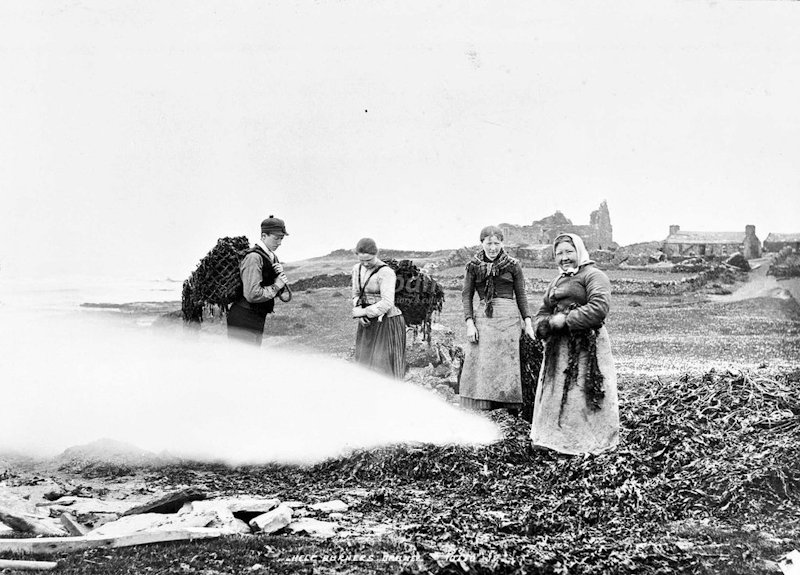
One of the factors that powered the move to crofting was the need to house the growing workforce involved in processing seaweed into kelp. Kelp production became a key element of the Orcadian economy. This is how Jane Lindsey put it:
Seaweed, when burned into ash, provided the alkali for making soap and glass – especially valued for the fine window glass that had become popular in the mid C18th. It could also be further processed elsewhere to extract iodine and silver iodide. By the early C19th 60,000 people were working in kelp manufacture in Scotland and £70,000 profit was being made in the Hebrides alone. At its peak crofters on Orkney were producing 3000 tonnes of kelp ash a year – it was worth £22 a tonne. The crofters were paid £2 a tonne. (Snapdragon Life)
Kelp-making is said to have begun in Orkney in 1721 through the efforts of James Fee of Whitehall in Stronsay. The kelp boom that followed reached its peak between 1770 and 1830. Production was spread across the islands, but there were particular centres such as Sanday, Stronsay and Westray. [If visiting Stronsay, check out the Heritage Trail]. This said, both Burray and South Ronaldsay were still producing around 125 tons per year in the 1790s (compared to around 1100 tons for the three islands above). The industry is said to have employed close to 3000 people across Orkney at its peak, and had major implications for shipping. However, it wasn’t without its opponents. Melting the kelp affected people’s eyesight and could lead to blindness (op. cit.). It was also blamed for the extreme famines resulting from crop failures and livestock loss between 1739 and 1742. This led to a major riot in Stronsay in May 1742, which, in turn, spread to other areas and islands. [Click to read a piece by Bill Miller on Orkney’s Kelp Riots]. With kelp prices dropping sharply after 1830, the activity wasn’t profitable. The result was significant job losses and localised depopulation.
Whaling, fishing and the Hudson Bay Company – the rise of Stromness
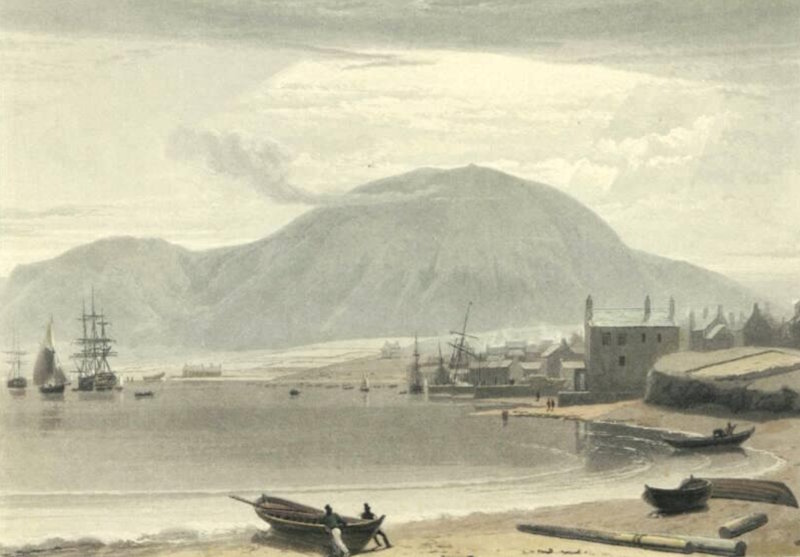
The sea had created other opportunities for work. Stromness became a key port for provisioning and recruiting crews for the Arctic whaling industry from around 1770 to 1870 (Arctic whaling looks to have begun around 40 years earlier). It was, for many years, a highly profitable but dangerous industry. Lobster fishing was also a significant feature of Scapa Flow. As Majorie Hebden reports, by 1775 live lobsters were being shipped to London (2011: 31). Deep-sea cod fishing and herring fishing were also growing from the 1750s. Other industries, such as straw plait manufacture and the manufacture of linen and woollen cloth, were in decline. The latter had ‘wholly ceased’ with the rise of new technologies some years later (Learmouth 1841). Stromness had grown both in size and economic significance, and much to the disgust of businesses in Kirkwall, they were the focus of attention.
A further important development was the establishment of the Hudson Bay Company. Charles II granted a charter in 1670 to create the company, which aimed to map a northwest passage to what is now known as Canada and to develop the largely unexplored area near Hudson Bay. The Orkney mainland was an obvious choice, as it offered a shorter, more direct route than almost anywhere else in what is now known as Britain, and had been used before in Norse times.
Stromness became the centre of the company’s activities in Orkney, receiving various goods from England and then dispatching them to Hudson Bay. The population of Stromness continued to increase, rising to 2199 in the 1794 census. Crucially, Orkney also became the main source of labour for the development of production in Canada. It grew to over 500 employees (mostly men) by the end of the eighteenth century, 80% of the total workforce. The company’s initial focus was the highly profitable trade in beaver fur, which it came to dominate. Over the years, it developed a range of additional activities.
The Hudson Bay Company required a range of jobs to be filled. These included guards, trappers, labourers, washerwomen and specialist posts such as doctors. John Rae (1813-3), the Orcadian who became famous as an explorer, was a qualified surgeon and worked for the company in the Bay area for around ten years. His father had also been the Hudson Bay Company’s chief representative in Orkney with a particular responsibility for hiring workers. The family home (the Hall of Clestrain in Orphir, a grade A listed building dating back to 1769) was across the bay from Stromness. Previously, the land had been owned by the Sinclair family.
Another important local figure involved with the Hudson Bay Company was William Tomison (1739-1829) from South Ronaldsay. At the age of 20 (in 1760), he signed on with the Hudson’s Bay Company as a labourer based in Canada. Over the years, he worked his way up the Company and became the inland chief. He retired in 1803 but soon wearied of the experience, returning in 1806 to take up junior roles. In 1810, he finally returned to South Ronaldsay. Having no direct heir, he bequeathed a large part of his accumulated wealth to establish a free school for local children (for more details, see Tomison’s Academy, a Category B listed building).
Social and political change
Here, we highlight three particular arenas of conflict and change: religious conflict, the power of local lairds, the impact of the Jacobites, and the development of schooling. Before we do that, however, it is worth noting that population size appears to have remained at close to the same level across the 1700s.
In the Webster survey conducted around 1750, there were just under 23,500 people in the islands. The death rate had fallen significantly thanks to improved diets, reduced famines and, in the 1750s, the introduction of smallpox inoculation (Hebden 2008: 34). At the same time, as we have already seen, emigration had grown. The 1801 survey recorded just under 24,500 residents. In 1861, it peaked at 32,395 and then declined to 52% of that number (17,000) in 1971. Today, the total population is close to 22,000 (2022).
Religious conflict and change
The Scottish Parliament made some important changes to the way that kirks operated. These included in 1712:
- restoring the lay patronage of parish livings. This entailed reducing the powers of local elders,
- stopping the Kirk’s power to contain Episcopalians (this said, Orkney had remained ‘staunchly Episcotarian’, Hebden 2008: 33), and
- removing the power of magistrates to enforce attendance and imprison excommunicated. (Marshall 2024: 384)
This said, the Church of Scotland remained central, with one of the central concerns being ‘forbidden sex’. This most significantly covered pregnancy (with women being ordered to name the father), and the punishment of adultery. It could mean that children could not be baptised unless the mother, in particular, showed repentance. For some, this entailed being restrained in a pillory. Some Sessions required the payment of a fine, and many local parishes came to require the payment of ‘marriage money’. This entailed the lodging of a sum of money that was held until the time of marriage. If a baby had appeared, the money was not returned [op. cit. 389].
Other areas for punishment included non-attendance at church on a Sunday, particularly where the person is working, unnecessary travel, such as visiting people on another island, and boys playing football. On other days, failure to attend funerals was seen as a problem. There appears to have been some recognition by local ministers that the weather is so bad that it would be silly to brave it (op. cit.: 400). There was another dimension to this. In many Kirks, we find a desire to help the poor and to work at reconciliation between neighbours. One further problem was the behaviour of the Ministers themselves. In the mid-1700s, there were various examples of inappropriate behaviour (op. cit. 402-12) and of a failure to appreciate the changing times they were operating in. As Peter Marshall (2024: 414) neatly puts it: ‘the people of Orkney were already standing on the cusp of modernity, but it was a modernity they would step into on their own, not the ministers’ terms’.
The Jacobites, the Battle of Culloden and Highland society
By Jacobitism, we mean the various efforts to restore the ‘Stuart monarchy’ following the Glorious Revolution in 1688. In Scotland, there were Stuart monarchs from 1371 to 1714. However, in 1688, King James VII (King James II in England) was forced to leave the British Islands for France. He was the last Roman Catholic monarch, and his ‘abdication’ was largely engineered by his Protestant daughter, Mary, and his son-in-law, William of Orange, with the support of the Scottish and English Parliaments. Mary and William became joint monarchs. The Scottish Parliament also took the opportunity to make Presbyterianism the state religion (sidelining the Protestant Episcopal Church). Queen Mary died in 1694, and William in 1702. Mary’s sister, Anne, also a Protestant, then ruled until 1714. She was the last of the Stuarts to head what became known as Great Britain following the Acts of Union in 1707. In 1714, the right to rule then passed to the House of Hanover. This ended in 1901 with the death of Queen Victoria. She had married Prince Albert of Saxe-Coburg-Gotha, and her son Edward took his family name from his father.
These events basically set up three key areas of division in Scotland: the Union, the restoration of the Stuarts and the dominant form of Protestantism (The National Trust for Scotland). In other words, there were:
- worries about the loss of national identity and political power;
- differences concerning to whom the royalty should be answerable (the Jacobites believed kings and queens were appointed by, and therefore accountable to, God rather than to society, etc.); and
- issues linked to the sidelining of both Catholicism and the Episcopal Churches.
What followed was an important series of events and battles in Scotland:
- The Battle of Killiecrankie (1689). This battle took place just north of Pitlochry and involved a Redcoat (government) army and an army put together by the 1st Viscount Dundee. It was said to be a victory for the latter (although he did die in the process).
- The Union of 1707, which brought together the parliaments of England and Scotland.
- The Battle of Sheriffmuir (1715) and the Battle of Glenshiel (1719). Both were lost by the Jacobites.
- The rise of Bonnie Prince Charlie. Following the defeat of the British army by the French at Fontenoy in 1745 (in what is now known as Belgium), Prince Charles Edward Stuart, James VII’s son, decided to invade. He raised his flag at Glenfinnan in August 1745 and captured Edinburgh in September. They then went south, but with winter approaching, they retreated to the Highlands. (Click for an overview of these events).
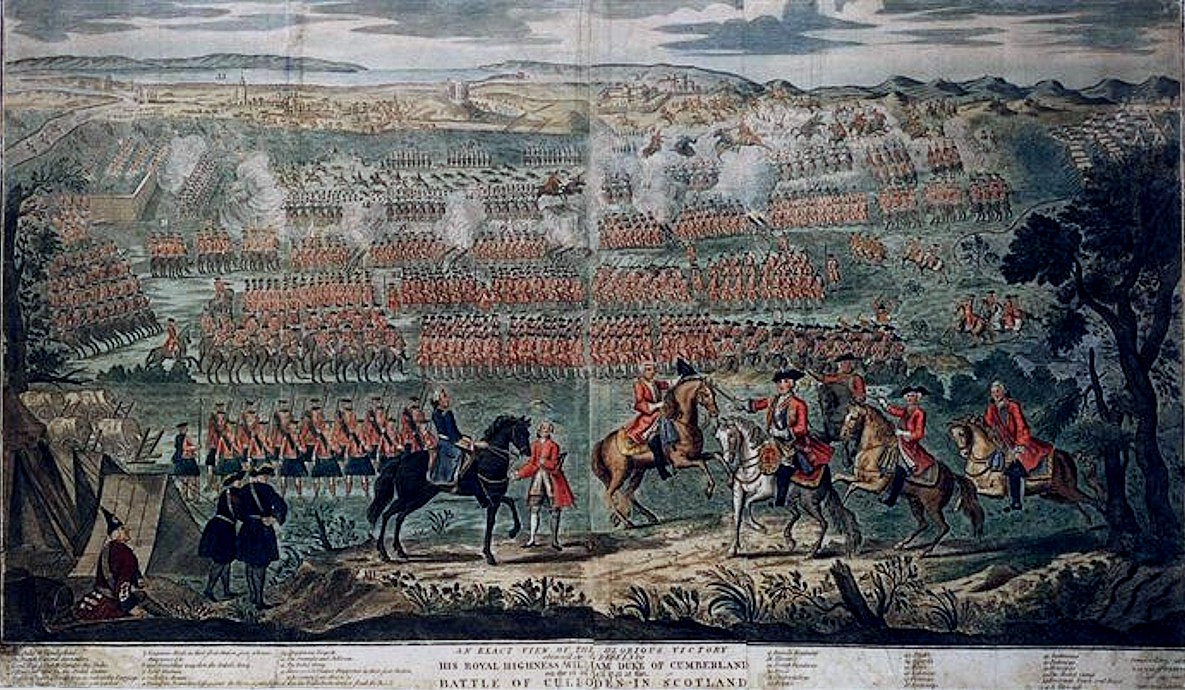
In April 1746, we have the defining battle – The Battle of Culloden, close by Inverness. The army raised by Bonnie Prince Charlie met a Redcoat army led by the Duke of Cumberland. It is said that in less than an hour, something like 1,600 men were killed, 1,500 of them Jacobites. This would be the last major battle ever fought on the British mainland. [Click to read an overview of the Battle from the National Trust for Scotland].
The Jacobite cause was seriously weakened, and the Government sought to ensure that something similar did not happen again. Troops were sent across Scotland to punish Jacobite sympathisers. They also looked to:
… dismantle the structures of Highland society. Clan chiefs were deprived of their legal powers and clansmen of their weapons; Jacobite estates were seized by the Crown; and the kilt and tartan were banned. (National Trust for Scotland)
Some big estates were taken over from Jacobite landowners by the government. Orkney did not escape this process. It is said there was significant sympathy for the Jacobite cause, particularly amongst the Lairds. In part, this was because the battles of 1715 and 1719 had sought refuge in Orkney (they were also helped to get to safety in Sweden) (Baynes 1970). The speed and scale of the response after the Battle of Culloden is that the Government army landed in Orkney just over a month later to deal with those with significant Jacobite sympathies.
Schooling
Before the Education (Scotland) Act 1872, most schools were subscription-based. By 1842, there appeared to have been six to eight such schools in South Ronaldsay and Burray. These could be quite small and operated from the teacher’s home, or larger units linked, for example, to a chapel or church. The first record of a school in Burray dates from 1627, but we know very little about it. The local Kirk Session agreed in 1666 to establish a school in the north district of South Ronaldsay. Stuart D B Picken (1979: 37) reports that Mr Walter Kynnaird was appointed as the first schoolmaster of the Hope School, before June 1666 (it is unclear where this was). The south district looks to have had one already (now known as the Old Schoolhouse).
There appear to be no schools for the children of poorer families (other than Sunday schools). In 1795, The Revd. James Watson, in his statistical study of the South Ronaldsay and Burray Parish, called for the erection of such a school in each island, along with a good road through the middle of both islands, and longer leases (19 years) for tenants, among other things. In South Ronaldsay, a Parochial School was established at Brandyquoy in the north of the island from 1815 (see below). For some time, there had been what appeared to be a subscription school in the South. Thanks to a large donation from William Tomison (who lived close to the subscription school), a free school, Tomison’s Academy, was built in 1851. It was in use until 1968.
The appearance of the school at Brandyquoy was linked to the work of the Society in Scotland for Propagating Christian Knowledge (SSPCK – founded in 1709). They recorded, for example, the appointment of a schoolmaster based at ‘Brandequoy’ [aka Brandiquoy or Brandyquoy], South Ronaldsay, from 1716-18. SSPCK in its early days had focused on evangelising what were seen as Catholic areas, particularly in the Highlands. Orkney did not fall into that group, so it may not have been a priority. In the last decade of the century, Brandyquoy still appeared to be the base for a schoolmaster. It appears that a local minister (presumably James Watson) was still trying to persuade the SSPCK to establish a Society school in the parish (Picken 1972: 45). It eventually arrived in 1815 at Brandyquoy [Click for map].
______
We are in the process of preparing the final sections for publication later in the year:
The revolution in farming, fishing, manufacturing, learning and communication – Orkney in the 1800s
World Wars, oil and alternative energy – Orkney in the 1900s
Further reading and references
Adomnán (1874). Life of Columba. (Edited by William Reeves). Edinburgh: Edmonston and Douglas. Download from the Internet Archive: https://archive.org/details/lifeofsaintcolum00adamuoft
Balfour, David (ed.) (1918). Oppressions of the Sixteenth Century in the Islands of Orkney and Zetland. Available from Project Gutenberg (open access). https://www.gutenberg.org/ebooks/58976.epub.noimages.
Baynes, John. (1970). The Jacobite Rising of 1715. London. Cassell.
Duffy, Christopher. (2003). The 45: Bonnie Prince Charlie and the Untold Story of the Jacobite Rising. London. Weidenfeld & Nicolson.
Edmonds, Mark. (2019). Orcadia. Land, sea and stone in Neolithic Orkney. London: Head of Zeus.
Foster, Sally M. (2014). Picts, Gaels and Scots. Early Scotland. Edinburgh: Birlinn.
Gerard, Rev. John (1855). United Parishes of South Ronaldsay and Burray. Statistical Accounts of Scotland – NSA Vol XV. https://stataccscot.ed.ac.uk/static/statacc/dist/viewer/nsa-vol15-Parish_record_for_Ronaldshay_and_Burray_in_the_county_of_Orkney_in_volume_15_of_account_2/
Grohse, Ian Peter (2021). ‘Late Medieval Vikings. The MacDonald raids on Orkney c1461’, https://www.ssns.org.uk/wp-content/uploads/2021/07/10_Grohse_InnerSeas_2017_pp_274-290.pdf .
Hebden, Rosemary. (2008). Eday. Orkney’s best-kept secret. Eday: Carrick Press. [The first chapter provides a concise overview of the history of Orkney.]
Hossack, Buckham Hugh. (1900). Kirkwall in the Orkneys. Kirkwall: William Peace and Son. https://archive.org/details/kirkwallinorkne00hossgoog/page/n14/mode/2up
Jackson, Clare. (2025). The Mirror of Great Britain: A Life of James VI & I. London: Allen Lane.
Learmonth, The Revd Peter. (1841). Parish of Stromness. The Statistical Accounts of Scotland 1791-1845. https://stataccscot.ed.ac.uk/data/pdfs/account2/StAS.2.15.26.P.Orkney.Stromness.pdf
Lindsey, Jane. (2021). The history of Scotland’s kelp industry, Snapdragon Life. [https://www.snapdragonlife.com/news/blog/the-history-of-scotlands-kelp-industry/].
Ljosland, Ragnhild and Woodsford-Dean, Helen. (undated). Witchcraft Trials in Orkney. Orkney Heritage Society (https://orkneyheritagesociety.org.uk/projects/orkney-witchcraft-trial-memorial/history-of-witchcraft-trials-in-orkney/)
Mackenzie, James (1750, 1836). The General Grievances and Oppression of the Isles of Orkney and Shetland. Edinburgh: Laing and Forbes. [Available in a Kindle edition from Amazon. Published by Kessinger Publishing]
McHardy, Stuart. (2011). A New History of the Picts. Edinburgh: Luath Press Limited.
 Marshall, Peter. (2024). Storm’s Edge. Life, death and magic in the Islands of Orkney. London: William Collins.
Miller, Bill. (2025). Stronsay’s Kelp Riots, The Orkney News. [https://theorkneynews.scot/2025/11/01/stronsays-kelp-riots/].
National Trust for Scotland. (undated). The Jacobites. https://www.nts.org.uk/learning/adult-learning/jacobites
Nicks, J. (2003). William Tomison in Dictionary of Canadian Biography, vol. 6. University of Toronto/Université Laval, 2003. https://www.biographi.ca/en/bio/tomison_william_6E.html.
Peace’s Orkney and Shetland Almanac and County Directory (1874). Kirkwall: William Peace. https://archive.org/details/peacesorkneyalma1874peac/page/n7/mode/2up
Picken, S. D. B. (1972). The Soul of an Orkney Parish. Kirkwall: The Kirkwall Press. https://archive.org/details/souloforkneypari0000stua.
Struthers, J. M. (2013). Broch Island. A history of the island of Burray in Orkney. Published by J. M. Struthers via lulu.com.
Stewart, Ian. (2025). The Celts. A modern history. Princeton and Oxford: Princeton University Press.
Sutherland, Ewan. (2020). Captain James Sutherland of Duffus (February 9, 2020). Available at SSRN: https://ssrn.com/abstract=3534959 or http://dx.doi.org/10.2139/ssrn.3534959.
Watson, The Revd Mr. James. (1795). United Parishes of South Ronaldsay and Burray. Statistical Accounts of Scotland – OSA Vol XV: https://stataccscot.ed.ac.uk/static/statacc/dist/viewer/osa-vol15-Parish_record_for_Ronaldshay_and_Burray_in_the_county_of_Orkney_in_volume_15_of_account_1/
Wickham-Jones, Caroline. (2013). Orkney. A historical guide. Edinburgh: Birlinn.
___
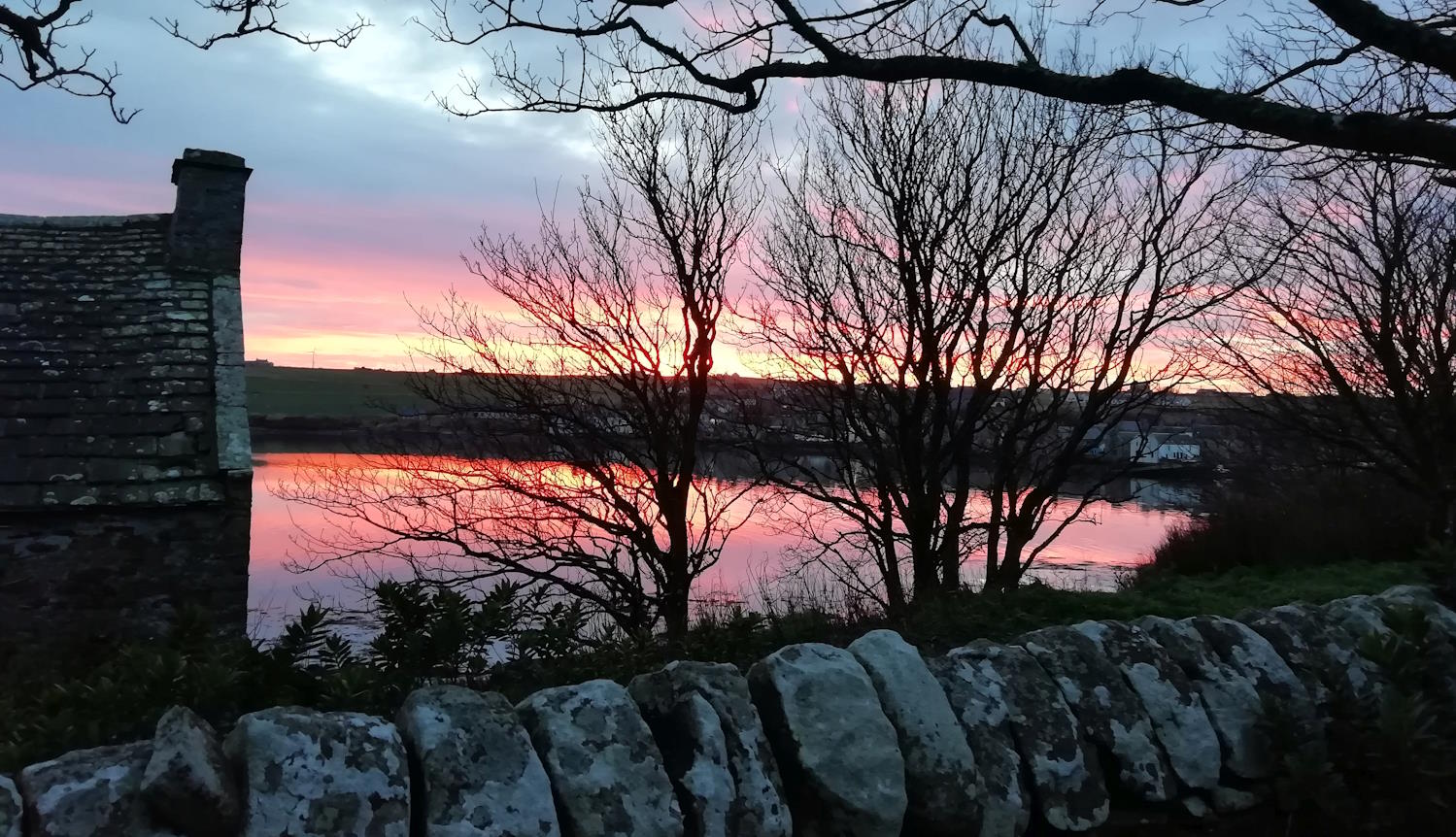
The opening photograph is of St Margaret’s Hope in January. The building on the left is the bothy at Smiddy Banks | mks – CC BY-NC-SA licence.
If you find any mistakes in this piece or think something needs adding, please let us know.
Referencing this page: Smith, Mark K. (2026). A (very) brief history of Burray and South Ronaldsay – the later years, Exploring South Ronaldsay. St Margaret’s Hope. [https://exploringsouthronaldsay.net/a-very-brief-history-of-burray-and-south-ronaldsay-the-later-years/]. Accessed: insert date]
updated: July 19, 2026